
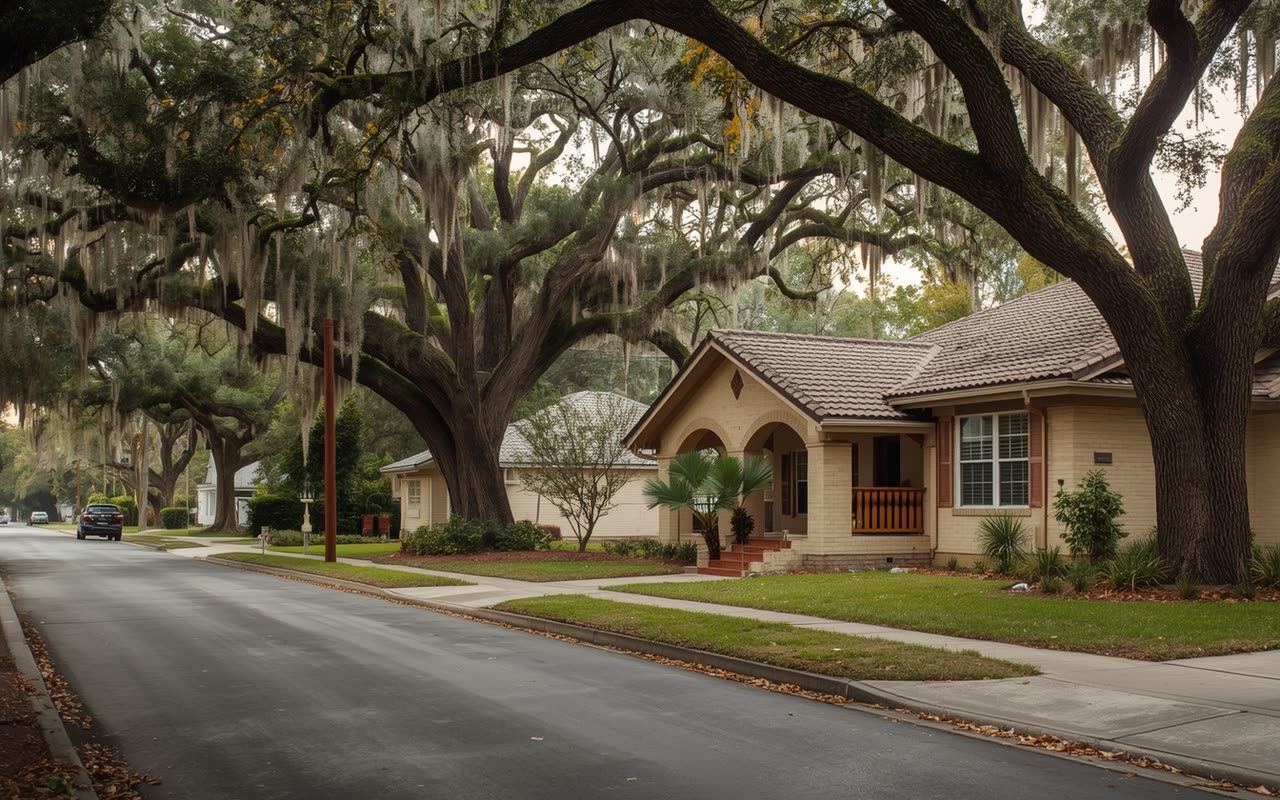
Temple Terrace is a small city that hugs the Hillsborough River northeast of downtown Tampa, and it has more character than a typical suburb. Some of its earliest houses date to the 1920s and carry the Mediterranean Revival look of that era: stucco walls, tile roofs and arched details. Most of the housing that surrounds them is mid-century, with single-story block ranches that went up in the decades after the war.
The tree canopy is what many people notice first. Large oaks and other mature trees shade the streets, and their roots and branches are part of how water behaves around a house here.
Two different house types, two different weak points
The 1920s-era homes. The oldest Temple Terrace houses are one of a kind, and many have had decades of remodels. Some sit on raised foundations with a crawl space and wood floors; others are on slabs. They may have thick masonry or stucco walls, original wood windows, clay or concrete tile roofs and plumbing that has been replaced in pieces over the years. In a raised house, water that gets under the floor can sit in the crawl space and soak the framing and the underside of the boards without showing above.
The mid-century block ranches. These sit mostly on slabs, with block walls, low-pitched roofs and a carport or garage. They have fewer quirks but plenty of age, and the usual weak points are the roof, the old supply lines and the water heater.
A practical rule: if your house is older than about fifty years and you do not know what the plumbing is made of, find out. A plumber can look at the supply lines and the drain pipes and tell you what you have and how much life it likely has left.
Old pipes under old houses
Older homes may have cast iron drain lines, copper supply lines of various ages, and in some cases galvanized steel. Cast iron corrodes from the inside and can crack or leak at joints, often under a slab or inside a wall where no one sees it. Copper can develop pinholes. Galvanized pipe narrows with scale and eventually fails.
Hints that a pipe is leaking out of sight include a slow rise in the water bill, a damp spot on the floor, a musty smell near a bathroom, and the sound of water when everything is turned off. When one gives way suddenly, read what to do about a burst pipe for the opening minutes, and extracting standing water is covered elsewhere on the site.
Tree roots and drains
Mature trees are an asset, and they also go looking for water. Roots can grow into older clay or cast iron sewer lines through small cracks and joints, slowly clogging them. A backup shows up first in the lowest drain in the house, such as a shower or floor drain, and the water that comes back is a sanitary problem, not just a wet floor.
Roots can also lift walkways and shift the soil around a foundation, opening gaps for rain. Branches that overhang a roof drop leaves into valleys and gutters, which dam up and force water under the edge of the roof covering. If you notice staining at the eave line inside, look at what has piled up outside.
The river
The Hillsborough River runs through the city, and residents of the lower areas near its banks have long known that heavy rain can bring the water up. Which streets are affected, and how much, depends on the elevation and on the storm, so avoid guessing about your own address. The county or the city can tell you the mapped flood zone, and your insurance agent can help you understand what your policy does and does not include.
Ordinary homeowner insurance tends not to pay for river flooding. That takes a separate flood policy, from NFIP or a private company, and the NFIP kind usually has a 30-day waiting period. Big repairs on a flooded house can cross the "substantial damage" line, often drawn near half the building's value, and that brings added requirements. Permitting staff in the city can explain how it would play out for you. When river water has been in the house, the material on flood damage restoration describes the typical steps, and a day-by-day guide to mold after hurricanes and floods puts them in sequence.
Where mold tends to show up
- The crawl space of a raised house. Dark growth on joists, damp insulation and a smell that travels up through floor registers.
- Wood floors that have cupped. Edges that lift or a springy feel often point to moisture below.
- Plaster and stucco walls near old windows. Wet stains that reappear after you repaint.
- Bathrooms with original ventilation. Older bathrooms often had a window and nothing more.
- Closets and cabinets against exterior block. Cool, still air and a wall that holds moisture.
- The ceiling below a tile roof leak. Tile roofs shed water well, but the underlayment beneath them is what keeps the house dry, and it ages.
If you find a small patch, about ten square feet or less, on a hard surface, federal EPA guidance suggests many owners can deal with it wearing an N95, gloves and eye protection. Growth under a floor, inside plaster or after river water is a bigger job. A mold inspection is a walk-through with moisture readings, useful when you cannot tell where the water is coming from, and mold removal is for the cases where growth is established.
Around the area
To the east, Brandon is a suburb of newer subdivisions with ponds and attic air handlers, a different set of problems from these older streets. The home page covers Tampa proper just to the southwest.
Who this helps
Owners of older Temple Terrace homes who are trying to understand a musty crawl space, a stain on a plaster wall or a sewer backup will find the most use here, as will buyers who are comparing a 1920s house with a 1960s ranch. Damp plaster and wet joists get worse by the hour, so do not sit on it.