
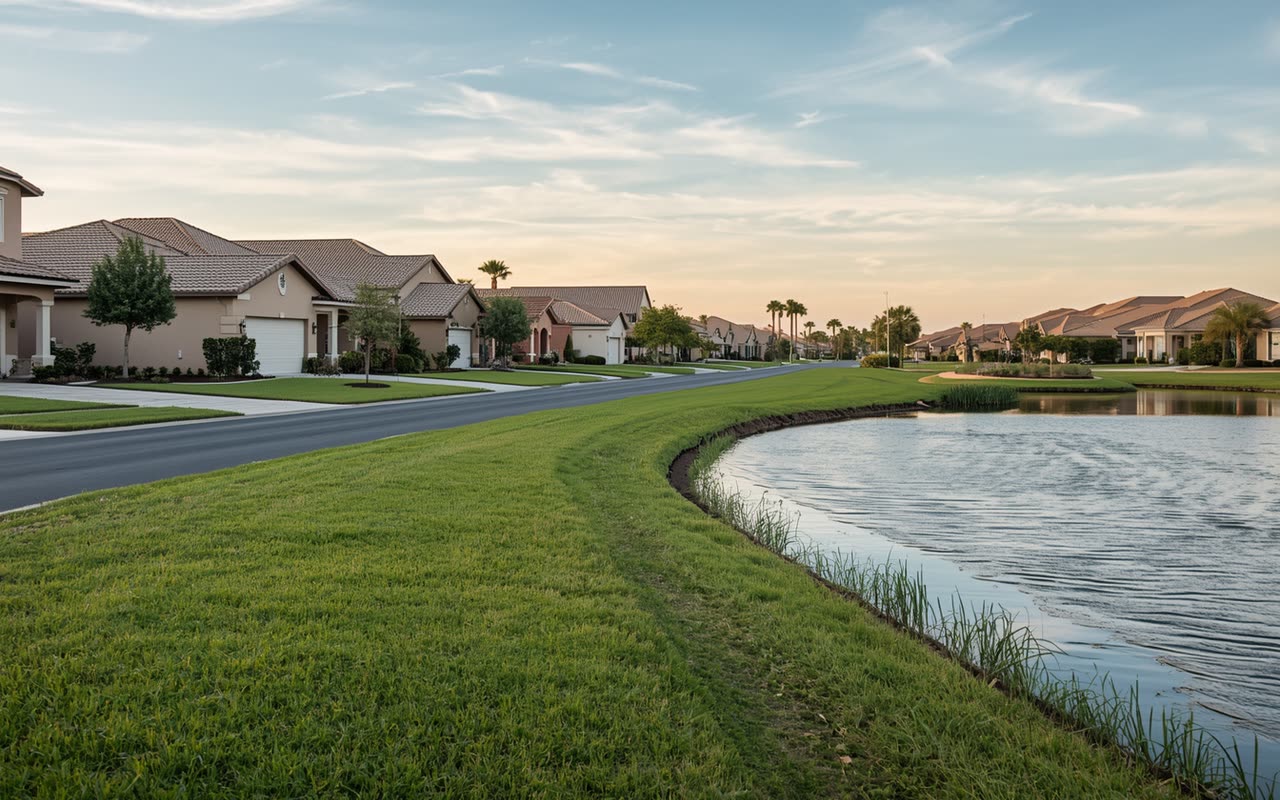
Riverview, in the southern part of Hillsborough County, is mostly the product of the last twenty-odd years of building. Farmland and open ground gave way to subdivision after subdivision, and many houses here date from the 2000s onward. They tend to be slab-on-grade, block on the first floor, sometimes with frame construction above, with stucco outside and an attic that holds the air conditioning.
New does not mean immune. Newer houses are often built tighter, with better sealing against outside air, which can hold moisture in when something goes wrong. And the speed of construction in a boom can leave small defects that only reveal themselves after a few rainy seasons.
What "newer" changes about moisture
A tight house is energy-efficient, but it does not breathe much. If a pipe drips behind a wall or rain gets past a window, there is little air movement to carry the moisture away. In a house built in the 1960s, drafts did some of that work by accident; in a house built in 2010, moisture often has to be dealt with on purpose, by finding it and drying it with equipment.
Some issues are typical of the building period:
- Post-construction moisture. Concrete slabs, framing lumber and drywall hold a lot of water when a house goes up, and that moisture works its way out over the first years. In a house that was closed up and cooled quickly, it can show as musty smells or growth in a corner.
- Builder-grade fixtures and fittings. Plastic supply fittings, flexible connectors and basic finishes are fine when installed correctly, but they have a limited life.
- Fast framing and finishing. Gaps in caulk, flashing that was not lapped quite right and window installations that were rushed leave small paths for water.
Stucco and window leaks
Stucco on a newer house is a good wall surface, and it also depends heavily on what is behind it. When water sneaks in around a window frame, a hose bib or a penetration for a light fixture, it can run down behind the finish for a long time before anything shows.
The warning signs are subtle: a soft or bubbling spot in the paint on the inside wall under a window, a dark stain on baseboards, or a dampness at the bottom corner of a window after rain. Walls under large windows and sliding doors are a classic place to look. If rain pushes against the house from one direction and you see damp only on that side, a window or stucco crack is a likely culprit. Our water damage restoration page explains how hidden wall moisture is traced and dried.
Ponds, low lots and the rivers
Riverview sits between two rivers, the Alafia to the north and the Little Manatee to the south. Many of its subdivisions have stormwater ponds, and some stretches are low and flat. After the 2024 storms, parts of this area saw water higher than residents had expected, and some neighborhoods near the rivers flooded, though conditions differ from one street to another and you should verify the facts for your own address.
What this means in practical terms:
- Find your flood zone. Ask the county, since a lot that looks high and dry may be mapped otherwise.
- Learn where your water goes. Know whether your lot drains to a pond, a ditch or the street, and keep those paths open.
- Sort out insurance before storm season. A standard homeowner policy usually leaves flood out. Coverage comes from NFIP or a private flood insurer, and an NFIP policy typically takes 30 days to start, so it cannot be bought the week a storm is forecast.
- Ask about substantial damage. When repair costs near half of what the building is worth, floodplain rules in many places add requirements. The county permitting office can explain how that works at your address.
If water does come in, the information on flood damage restoration and the longer guide to mold once the water has gone down cover what to do and in what order.
The attic air handler and the ceiling below
Like many newer Hillsborough County homes, a lot of Riverview houses put the air handler in the attic, often with a secondary drain pan and a float switch. These help, but they do not replace maintenance.
A condensate line that clogs can overflow into the pan and, if the switch fails or was never installed, into the ceiling. Look for a stain in the hallway ceiling near the access panel, water marks around recessed lights and a ceiling that sags even slightly. Ductwork in a hot attic can also form condensation if the insulation is damaged or the vapor barrier is torn.
Large two-story houses are common here, so a leak upstairs can come down through a ceiling and a wall into the room below. If you notice drops at a light fixture, switch off the circuit before you do anything else.
Where mold tends to show up
- At the lower corners of walls in rooms with large windows
- Inside closets on the north or east side
- On the ceiling and walls of a bathroom that has a weak or disconnected exhaust fan
- Around the base of a toilet or under a vanity where a supply connector has been seeping
- On the underside of attic decking after a roof or ventilation problem
- Behind garage-adjacent walls that took in rain at the door
EPA guidance leaves a patch under roughly ten square feet on a hard surface to the homeowner, with an N95 mask, gloves and goggles. When it is larger, hidden or tied to a water source you cannot find, a mold inspection combines moisture meter and infrared readings, and mold removal deals with whatever turns up.
The neighborhood next door
Heading north, Brandon has an older suburban mix with its own roof and attic issues. The home page covers Tampa, and you can see every area we cover on the service areas page.
Who this helps
Riverview owners who bought a newer house and found a stain, a smell or a damp wall, and wonder whether it is a builder defect or something else, can use this page to sort out what is likely and what to check first. Moisture keeps working overnight and on weekends, so a call sooner is better than a call later.