
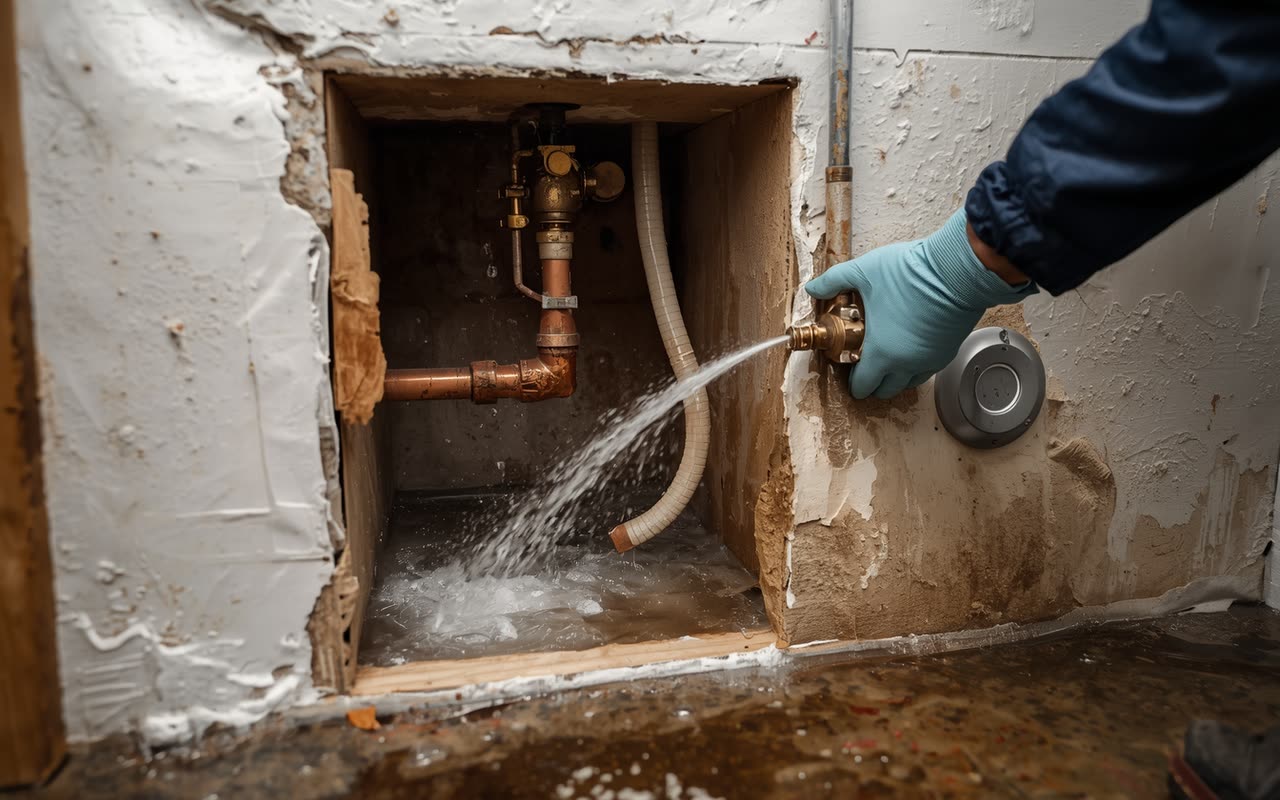
People in Florida tend to think burst pipes are a northern problem. They are not, and most plumbing damage in Tampa Bay homes has nothing to do with freezing. It comes from aging pipes, failed hoses, tired water heaters and a slab foundation that hides the plumbing under a few inches of concrete.
This page covers where the water in a Tampa-area house usually comes from, how to find and shut off a leak, how to tell if you might have a slab leak, what a plumber does compared with a water damage specialist, and what happens inside walls and cabinets when a leak goes unnoticed. It also covers the first hour, what dries and what goes, and the mold timeline.
Where leaks come from in a Florida house
Rare hard freezes. Tampa Bay does get the occasional night below freezing. When it does, exposed pipes on the outside of a house, in an unheated garage or in an attic, along with irrigation lines, backflow preventers and hose bibs, can split. Many Florida homes were built without freeze protection because it is rarely needed, so the damage can be sudden and large. The pipe often splits during the freeze and does not leak until it thaws, so the water shows up the next morning.
Pinhole leaks in older copper. Copper pipe lasts a long time, but water chemistry, age and installation problems can wear tiny holes in the pipe wall. A pinhole sprays a fine mist or drips for weeks or months before anyone notices. It often shows up as staining on a ceiling or wall, a musty smell in a cabinet, or rust on a fitting.
Slab leaks. Many Tampa homes have supply lines running through or under the concrete slab. A leak in that line pushes water up through the slab, sideways under flooring, or into the soil under the house. More on this below.
Water heater failures. A tank water heater has a limited service life. When the tank corrodes through or a fitting fails, it can release many gallons of water. In Florida the heater is often in a garage, an interior closet or a utility room, and a closet leak spreads into nearby walls and flooring before it is noticed.
Washing machine and ice maker supply lines. Rubber hoses harden, crack and burst. Braided stainless hoses last longer but can fail at the fitting. The ice maker line behind a refrigerator is a small tube that can run for days unnoticed.
Toilet supply lines and fill valves. The little flexible line from the wall to the toilet tank is a common failure. So is a toilet that quietly overflows or leaks from the wax ring, which can soak the floor under and around it.
AC condensate overflow. An air conditioner in Florida removes gallons of water from the air every day. If the condensate drain line clogs, the pan fills and overflows into the ceiling, closet or wall. It often goes unnoticed until a ceiling stain appears. This is not a plumbing line, but it behaves like a leak and causes similar damage.
Roof leaks that look like plumbing. A stain on a ceiling or wall that appears after a rainstorm is often a roof issue, particularly around tile roof flashing, vents and valleys. If it shows up only after it rains, the roof is the likely source. If it shows up whether or not it rains, it is more likely plumbing or AC.
Other sources. Dishwasher lines, sink drains, shower pans and tub overflows, and irrigation lines near the foundation can all contribute. A leak in a shower pan or a tub drain can run behind the tile for months.
How to find and shut off the water
The first priority when a pipe is leaking is to turn off the water. Know where the shutoffs are before you need them.
The fixture shutoff. Under sinks and behind toilets you will find small valves, usually oval or round. Turning them clockwise closes the line to that fixture. This is the quickest way to stop a leak at a toilet, sink or faucet.
The main shutoff. Every house has a main shutoff. In many Tampa Bay houses it is on an outside wall, near the front of the house or by the hose bib, or in the garage near the water heater. Look for a gate or ball valve on the pipe where it enters the house. If you cannot find one, there is usually a valve at the meter box near the street. It sits under a plastic or metal lid in the ground. The valve there may need a tool. A pair of pliers or a meter key can turn it, but be careful because it can be stiff or the box can have insects or snakes.
A quick meter check. If you suspect a leak but cannot see one, you can check the water meter. Turn off every fixture and appliance that uses water: dishwasher, washing machine, ice maker, irrigation. Look at the meter. Most have a small dial, triangle or flow indicator that spins when water is moving. If it is moving when nothing is using water, there is a leak somewhere between the meter and the house or inside. Take a photo of the reading, wait an hour with no water use, and look again. If the number has changed, the leak is real.
Narrowing it down. If the meter moves, turn off the main shutoff at the house. If the meter stops, the leak is inside the house or in the line after the shutoff. If it keeps moving, the leak is in the underground line between the meter and the house. That helps a plumber know where to look.
Signs of a slab leak
A slab leak is a leak in a pipe running through or under the concrete. Because you cannot see it, it takes some detective work. Common signs:
- A warm spot on the floor. If the leaking line is a hot water line, the floor above it may feel warm to the touch or even uncomfortable on bare feet.
- The sound of running water. A faint hissing or trickling noise when everything is off. Put your ear to the floor or a wall.
- An unexplained jump in the water bill. A line that is leaking constantly can double or triple a bill.
- A meter that keeps moving when all water is off.
- Wet or stained baseboards, or flooring that is damp, buckling or lifting, particularly in one area of the house.
- Cracks in the slab or in tile that was fine before.
- Low water pressure or a pressure that drops over time.
- A musty smell in a room with no obvious source.
- A wet spot in the yard next to the foundation, or soggy ground along the slab edge.
One or two of these signs is a reason to look closer. Several together is a strong hint. Each of these can have other explanations, and only a professional leak check can confirm a slab leak.
What leak detection involves
When a leak is hidden, a specialist or plumber uses tools to locate it without ripping up the house. Depending on the situation, that can include:
- Pressure checks that isolate sections of the plumbing to see whether pressure holds.
- Acoustic listening equipment that picks up the sound of water escaping from a pipe, through a floor or wall.
- Thermal imaging that finds temperature differences from a hot water leak or evaporative cooling from a wet area.
- Moisture meters that read dampness in drywall, flooring and cabinets without cutting.
- Tracer or camera inspection in some drain and sewer situations.
Finding the leak is a different skill from drying the damage. A plumber finds and repairs the pipe. A water damage specialist maps where the water went, extracts it and dries the structure. Often both are needed, and the order matters.
Plumber or water damage specialist: who does what
It is common to wonder who to call first. The short answer is: stop the water yourself if you can, then call whoever can reach you first, and make sure both get involved.
A plumber locates and repairs the failed pipe, fitting, valve or fixture. For a slab leak, that may mean rerouting the line through the attic, or breaking through the slab to repair it. A plumber is not trained or equipped to dry a building, and a repaired pipe does not mean the wall is dry.
A water damage specialist deals with the water that has already escaped. That means extracting standing water, opening and drying walls, floors and cabinets, controlling humidity and monitoring the moisture readings until the structure reaches its dry reference. A specialist can help you document the loss for your insurer. They do not fix the plumbing.
The most common mistake is stopping at the plumber. A leak fixed on Tuesday with a wall that is still wet on Friday is a mold project in progress. The second most common mistake is starting the dry-out before the leak is fixed, which means the crew is drying a building that is still getting wet.
How hidden leaks wreck walls and cabinets
When a pipe leaks inside a wall or under a floor, the damage develops in a pattern that is worth understanding because it explains why the repair can be larger than the leak looks.
Water wicks. Drywall acts like a wick. Water entering at the bottom of a wall climbs upward through the paper and gypsum, sometimes a foot or more. A small, steady leak can wet the entire lower half of a wall.
Cavities hold moisture. The space between studs is a closed cavity. Water that runs down inside it pools at the bottom plate, where the wall meets the floor, and soaks the wood and any insulation. Because there is no airflow, it stays wet.
Paint hides it. The surface can look fine for weeks. Paint is a thin barrier that may blister, bubble or stain only after the wall is thoroughly wet. By then, the inside may be soft and moldy.
Cabinets trap moisture. The inside of a base cabinet under a kitchen or bathroom sink is a closed, warm, dark space with a hole in the back for the pipes. A slow leak from a supply line or a drain connection wets the cabinet floor, the back wall and the wall behind it. MDF and particleboard cabinets swell and fall apart. Mold grows on the back of the cabinet and in the wall behind it.
Flooring hides it too. Water that gets under laminate, vinyl plank or engineered wood can sit on the subfloor for a long time. Floors that feel slightly bouncy, smell musty, or have raised edges are worth investigating.
Slab moisture comes back. A slab leak can saturate the soil under the house and the concrete itself. Even after the pipe is fixed, the slab can release moisture for a while, which affects flooring placed over it.
A leak that has been running for months may require opening a lot more than a leak found within hours. That is not the restoration company being cautious. It is how water behaves inside a building.
The first hour after you find a leak
Think of the first hour as a short checklist.
- Stop the water. Fixture shutoff, then main shutoff. If the leak is from a water heater, shut the cold water supply valve above it and turn off its power at the breaker.
- Make it safe. If water is near outlets, appliances or the panel, stay clear of it and turn off the breakers only if you can reach the panel without standing in water. If a ceiling is bulging, stay out from under it.
- Photograph everything. The source, the damage, the water line and the rooms involved. Take a short video.
- Remove what you safely can. Pull up small rugs, move furniture and valuables off wet floors, and pick up standing water with towels or a wet vacuum made for water pickup. Do not use household vacuums.
- Call a water damage specialist and, if the pipe is still broken, a plumber. Say what happened, where, how long and whether the source is off. Water does not wait for business hours, so call as soon as you see it.
- Call your insurer to report the loss. They may have steps you need to follow and a time frame for reporting. Read your policy before deciding anything about repairs.
- Keep the damaged part. If a hose, valve or fitting failed, set it aside. The insurer or a plumber may want to see it.
More detail on the first day is in the first 24 hours after water damage, and a step-by-step on extraction is on the emergency water removal page.
What dries and what goes
Whether a material can be dried or must be removed depends on the type of water, how long it was wet and what it is. Supply line water is the lowest-risk case, but it does not stay that way for long in Florida heat. The following is a general guide.
Usually dried in place:
- Solid wood framing and structural lumber.
- Concrete and the slab, with time.
- Tile and stone surfaces, though the substrate may need attention.
- Drywall that was wet briefly with supply line water, is still firm and is not stained or swollen.
- Solid wood and plywood cabinets, after opening the toe kick and the back.
Often removed:
- Drywall that has been wet for a day or more, is soft or has begun to grow mold.
- Baseboards that have swelled or are lifting.
- Carpet padding.
- Wet insulation in the wall cavity.
- Particleboard and MDF cabinet boxes and shelving.
- Laminate and engineered flooring that has swollen.
- Anything in contact with a drain or sewer leak.
Case by case:
- Hardwood floors, which may be dried with specialty equipment if caught early, but may also cup and warp.
- Carpet, which can sometimes be extracted and dried when the water is from a supply line and the loss is fresh.
- Plywood subfloor, which is often dried unless it has delaminated or grown mold.
A good specialist will explain each decision with a reading or something you can see. If they open a wall, ask what the readings were and what they found inside. For the full process of how structural drying works, see water damage restoration.
Mold risk and timeline after a leak
Mold needs moisture, a food source and time. A leak provides all three. Drywall paper, wood framing, insulation facing and cabinet backs are all food for mold, and in a warm Florida house, wet materials can begin to grow it in about 24 to 48 hours. That is a general working window, not a precise timer.
Leaks that go on for weeks or months almost always have mold by the time they are found. Signs include:
- A musty smell, particularly in a closet or cabinet near the leak.
- Dark or fuzzy patches on the back of cabinets, on the wall behind the toilet or at the base of drywall.
- Staining, peeling paint or bubbling wallpaper.
- Allergy-like symptoms that improve when you are away from the house.
The EPA says that a patch of mold on a hard surface under roughly 10 square feet can often be handled by the homeowner, with an N95 respirator, gloves and eye protection, once the moisture source is fixed. Mold on drywall, insulation or other porous materials, larger areas, or growth inside walls usually calls for a professional. See mold removal for how that work is done, and humidity and mold in Florida homes for why wet materials grow mold so fast here.
If a leak was found quickly, the plumbing was repaired and the structure was dried to its reference readings, mold typically does not follow. The point of fast action is that it prevents the second project.
Insurance and documentation
If you plan to file a claim for a leak, documentation helps. Take photos and video, keep the failed part, save the plumber's invoice and ask your specialist for moisture readings and a list of materials removed. We do not handle your claim, and nobody can promise what your policy will pay. Many homeowner policies cover sudden and accidental discharge, such as a burst pipe or a failed water heater, and treat long-term seepage and repeated leakage differently. Many policies also cap or limit mold coverage. Reading your policy before you decide on repairs is worth the time. Your insurer decides what is covered.
Preventing the next one
You cannot prevent every leak, but a few habits reduce the risk and make a leak easier to catch.
- Learn where your main shutoff is and make sure it turns. A valve that has not moved in a decade may be stuck.
- Replace rubber washing machine hoses with braided stainless steel hoses, and check them every year or two.
- Look at the ice maker line and the toilet supply lines when you move the refrigerator or reach behind the toilet.
- Check under sinks whenever you open the cabinet. A damp cabinet floor or a stain is an early warning.
- Flush the AC condensate line on a regular schedule, or have the AC service include it. A float switch on the drain pan can shut the system off before it overflows.
- Watch the water bill. A sudden increase with no change in use is a prompt to do a meter check.
- Keep an eye on the water heater. If it is old, rusting, leaking at the base or in a spot where a failure would flood the house, consider replacing it before it fails and consider a drain pan with a line to a safe drain.
- Protect against rare freezes. On the few nights each winter when a hard freeze is forecast, cover exposed pipes and hose bibs, open cabinet doors on exterior walls, and let a faucet drip.
Questions people ask
How do I know if I have a slab leak?
Signs include a warm spot on the floor, the sound of running water when everything is off, an unexplained jump in the water bill, a water meter that keeps moving with all fixtures off, wet or stained baseboards and damp or buckling flooring. Each sign can have other causes, so confirmation takes a pressure check or acoustic leak detection by a professional. If you suspect one, turn off the main water to limit the damage until it is checked.
Who should I call first, a plumber or a water damage company?
Stop the water yourself first by closing the fixture shutoff or the main. Then call both. The plumber repairs the pipe, and the water damage specialist extracts the water and dries the structure. If the water is still coming, the plumber comes first so the dry-out is not working against an active leak. If the pipe is already shut off and there is standing water or wet walls, the specialist should not wait for the repair to be finished.
How long does it take for mold to grow after a pipe leak?
In warm, humid conditions mold can begin growing on wet drywall, wood and other building materials in about 24 to 48 hours. That is a general window, not a firm rule in either direction. A leak that was dried properly and quickly usually does not lead to mold. A leak that ran for days or weeks, or one hidden in a wall or cabinet, often does by the time it is found.
Will my homeowner's insurance cover a burst pipe?
It depends on your policy. Many cover sudden and accidental water damage from a burst pipe or failed appliance, and are less generous with long-term leaks or seepage. They may also have limits on mold. The plumbing repair itself is often not covered even when the resulting water damage is. Call your insurer, read your policy and ask what documentation they require. The restoration company can provide photos, moisture readings and a scope of work, but the insurer decides coverage.
Can a hard freeze really burst pipes in Tampa?
It is rare, but yes. When temperatures drop below freezing for several hours, exposed pipes, outdoor hose bibs, irrigation lines, backflow preventers and pipes in unheated garages or attics can crack. Because many Florida homes were not built with freeze protection in mind, the damage can be larger than people expect. The water often shows up when the pipe thaws, not when it freezes.
What should I do if I see a ceiling stain after a rainstorm?
Check whether it appears only after rain or all the time. If it appears only after rain, it is likely a roof leak at flashing, a tile or a vent. If it appears regardless of weather, suspect plumbing or an AC condensate line. Place a bucket under any drip, take photos, and if the ceiling is bulging, stay out from under it. A small controlled hole at the lowest point of a bulge can let water drain safely. Call a specialist before the stained drywall dries and hides the cause.
Does the water damage have to be repaired if I cannot see anything wrong?
If the leak was found and fixed quickly and the readings are normal, there may be nothing to repair. If the leak was long-running, hidden or in a spot where water could sit, the safe step is a moisture check of the area. A specialist with a meter and thermal camera can tell you whether the wall is dry without cutting it open. If the readings are high, opening the wall is better than leaving it closed. See mold inspection for how a visual and moisture inspection works.