
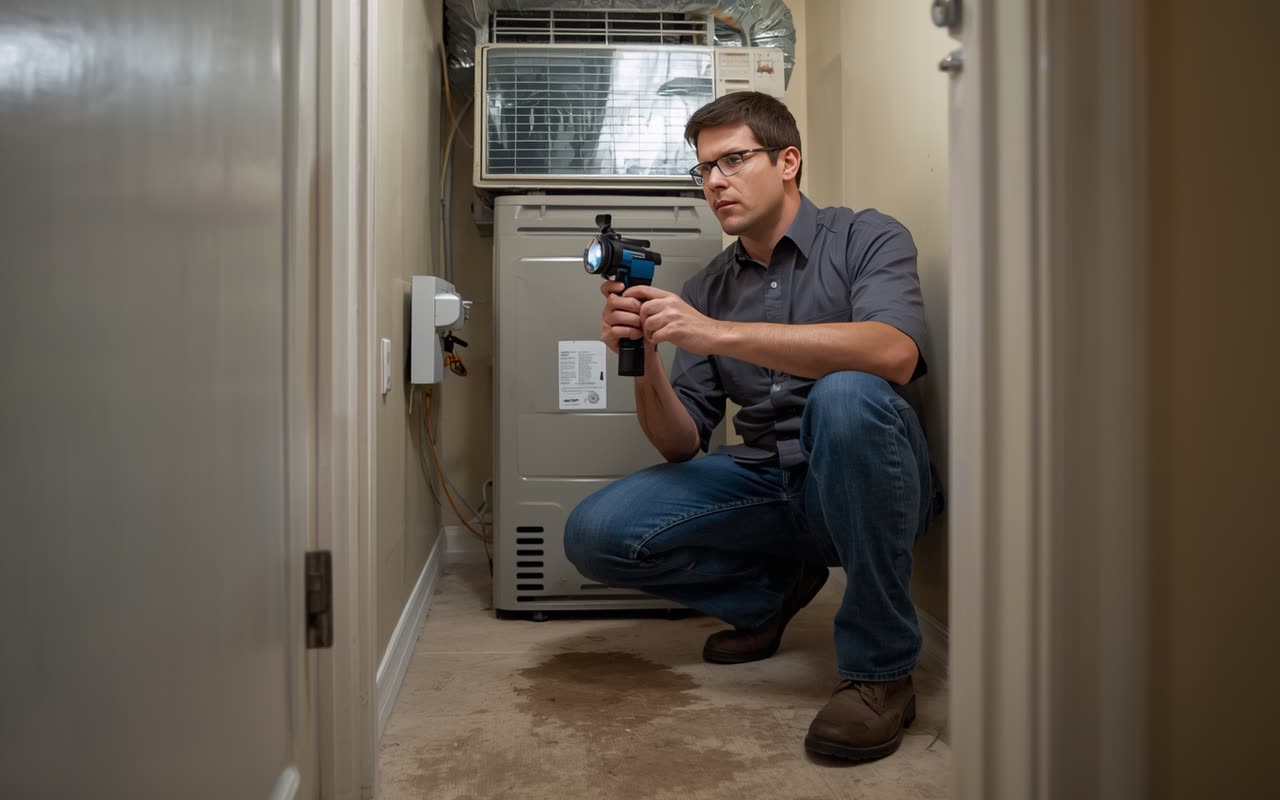
Some mold problems announce themselves. Others are a smell in a hallway that comes and goes, a ceiling stain that is slightly bigger than last month, or a baseboard that is a little softer than it should be. In a house with nothing obvious to point at, the useful first question is not "what kind of mold is it?" but "where is the water, and how far has it gone?"
That is what a moisture and mold inspection answers. It is a visual inspection backed by instruments: a moisture meter, a thermal imaging camera and humidity readings. It is a look at the house by someone who knows how water behaves in Florida construction, followed by written findings you can use to decide what to do next.
What the inspection actually is
Think of it as finding the story of the water. Mold needs moisture, so wherever mold is, something is or was wet. The inspection works backward from what you can see and smell to what is behind it.
- A visual walk-through. Ceilings, walls, baseboards, window and door frames, floors, cabinets, closets, the attic access and the exterior all tell you something. Stains, bubbling paint, swollen trim, rust, efflorescence (white mineral deposits) and visible growth are all noted.
- A moisture meter. A pin or pinless meter reads moisture content in drywall, wood and other materials. It tells you whether a surface that looks dry actually is, and it maps the edges of a wet area.
- A thermal camera. An infrared camera shows temperature differences on a surface. Wet materials are often cooler than dry ones around them because of evaporation, so a thermal image can reveal a pattern you cannot see, such as a trail of moisture running along a wall or up from a slab. A thermal image is a clue that is then confirmed with the moisture meter, not a diagnosis on its own.
- Humidity and temperature readings. Relative humidity and temperature in the rooms, and at times near an air handler or on a cold surface, show whether the air itself is the issue. Readings above about 60 percent in a lived-in house point to a moisture control problem even when nothing is leaking.
This is a visual inspection, not a laboratory exercise. You get an informed read on where moisture is, how far it spreads and what likely caused it.
Room by room in a Florida home
Every house has its own weak spots, but the same places turn up in Tampa Bay homes so often that an inspection starts with them.
The AC closet and air handler
If the air handler is in a closet or hall, this is where an inspection often begins. The things to look at: the drain pan under or around the unit, the condensate drain line and its connection, signs of overflow such as stained flooring or rusty metal, insulation that is wet or missing on the plenum and ducts, and damp drywall at the bottom of the closet. A clogged drain line is a quiet, common source of repeated damage.
Ceilings below roofs
Ceilings under a roof surface get a careful look: stains and rings, bubbling or sagging, and the pattern. A single round stain below a vent pipe or a tile valley suggests a roof leak. A long stain that follows a duct or runs along a ceiling line often suggests a supply duct sweating or a leak at the boot. Thermal imaging helps here, since a ceiling can be wet above the paint.
Behind toilets and under sinks
Small leaks last for years in these places. The supply line to the toilet, the wax ring at the floor, the shutoff valve, the drain trap and the sink supply lines are checked. So is the base of the cabinet: a soft, swollen or stained cabinet floor is a good indicator, as is a musty smell when you open the doors. Behind a toilet is where a slow wax ring leak soaks the subfloor.
Garage water heaters
A water heater in a Florida garage sits on a slab, often with a pan and a drain, and it works for years before it leaks. Corrosion at the base, a wet pan, a damp wall beside it and a damp slab are checked. A leaking relief valve line and a failed tank both leave signs. In many houses the garage wall behind the heater shares framing with a bedroom or living space.
The slab perimeter
In a slab house, water and moisture often show up at the bottom of walls and at the edge where the slab meets the wall. The inspection looks at baseboards, the base of drywall, flooring along exterior walls, and the outside: how the grade slopes, whether soil sits above the slab edge, whether sprinklers are hitting the wall, and what the downspouts are doing. Slab leaks in supply lines sometimes produce a warm spot on a floor, a sound of running water when everything is off, or a sudden jump in the water bill, and those clues are noted for a plumber to confirm.
Windows, doors and exterior walls
Window frames, sills and the drywall below them are common sites. Failed sealant, stucco cracks and flashing problems let wind-driven rain in during summer storms. Walls with vinyl wallpaper on the inside of an exterior wall get special attention, because moisture can sit behind the vinyl and stay hidden for a long time.
Bathrooms and laundry rooms
Is the exhaust fan moving air, and where does it vent? Is the caulk sound around the tub and shower? Is the drywall on the shared wall behind the shower dry? The laundry room gets a look at the washing machine hoses, shutoff valves and the floor and wall behind the machine.
The attic
If the attic is safely accessible, it gets looked at, mainly from the opening. The inspection notes insulation condition, staining on the roof deck, ducts and their insulation, whether bath fans are connected to a vent that reaches outside, and whether soffit vents are blocked. Florida attics are hot and often humid, and conditions can be difficult. Where the attic cannot be reached safely, it is noted as not inspected rather than guessed at.
Crawl spaces on older homes
In older bungalows with raised floors, the crawl space gets checked for standing water, vapor, damp soil, wet insulation, plumbing leaks and the condition of the wood. Where access is too tight or unsafe, that is stated in the findings.
What the written findings contain
After the visit you should receive a written summary rather than a verbal "looks okay." What it should include:
- The areas looked at, and the areas not accessible. Honest limits matter. A report that quietly skips the attic is worse than one that says the attic was not reached.
- What was found, with photos. Visible growth, stains, damaged materials and the instrument readings taken at each location.
- Moisture readings. Wet versus dry, with a reference reading from an unaffected area of the same house so you can see how far off the wet areas are.
- Thermal images of any suspect areas with a note on how they compare to the meter readings.
- The likely water source. What the evidence suggests (a clogged AC drain, a roof leak, a plumbing leak, condensation, high indoor humidity, a bath fan venting into the attic) and what is not clear and needs a specialist, such as a plumber or roofer.
- How far the damage extends, in plain terms: which rooms, which walls, which materials.
- Recommended next steps in order. Fix the source, then what comes out, what can be dried in place, and what a drying and rebuild plan would look like.
The point is not to produce a thick report. It is to leave you knowing what is wrong, where, and in what order to deal with it.
What a visit is like
Most visits are a couple of hours for an average home, depending on size and how much needs to be followed. You walk the house with the inspector if you like and describe what you have noticed: when the smell shows up, which rooms, whether it is worse after rain or when the AC runs, any past leaks or repairs. Those details save time.
The inspector will check the rooms you are worried about first, then the places that commonly hold hidden problems. They will take meter readings, photograph what they find, and use the thermal camera on walls and ceilings. They may open an access panel or lift a trim piece if it is simple and non-destructive, but a visual inspection does not mean cutting holes in your walls. If the evidence points to something behind the wall that needs opening up, that is noted as the next step, with your agreement.
You should expect plain talk at the end of the visit about what was seen, even before the written findings arrive.
How to prepare
A little preparation makes the visit more useful.
- Make the areas reachable. Move furniture away from the walls in rooms of concern and clear the closet floors. Make sure the AC closet, garage and attic access are not blocked.
- Do not scrub or paint the area first. It is tempting to wipe or paint a stained spot before someone arrives. Leave it as it is.
- Keep the AC on and running normally. Humidity readings mean more when the house is in its normal state.
- Write down the history. Past roof repairs, plumbing leaks, storm damage, an AC overflow, a flooded garage, a period when the house was closed up. Note when the smell started and whether it changes with weather.
- Gather paperwork. If you have previous repair invoices, an old inspection report or an insurance claim number, have them handy.
- Secure pets and let the inspector know about any health concerns in the house.
- Know where the attic access, water shutoffs and breaker panel are.
When an inspection is worth it
A moisture and mold inspection earns its keep in a few clear situations.
A musty smell with nothing visible. This is the classic. A smell that is stronger in the morning, when the AC first runs, or in a closet, bathroom or one room usually means damp material somewhere. Looking is cheaper than opening walls at random.
After a leak, storm or flood. After a roof leak, an AC overflow, a plumbing failure or a storm, materials may look dry on the surface while holding moisture. Checking with a meter and thermal camera tells you whether the drying was enough, and where it was missed. After the 2024 storms, many homes in Tampa Bay needed this kind of check weeks after the water went down. The guide on mold after a hurricane or flood covers the timeline.
Before buying a house, or before closing up a seasonal one. A buyer can learn about moisture history and hidden problems before the sale is final. A seasonal owner who leaves for the summer can confirm the house is dry and the humidity is controlled before locking it up, and again on return.
After a repair, before you rebuild. If a leak was fixed and walls were dried, readings confirm it before drywall goes back up.
When symptoms and the house seem connected. If family members are having breathing or allergy trouble that eases away from home, an inspection looks for the moisture side. It does not diagnose illness. Talk to a doctor about that.
When you are unsure whether you need a mold removal crew. If you are near the 10 square foot line, or you cannot see how far something goes, an inspection resolves the question.
An inspection is often not needed when you can see a small patch on a hard surface, you know the source and you have already fixed it. In that case, the do-it-yourself guidance on the mold removal page may be all you require. And if the water damage is recent and obvious, such as a pipe that just burst, the first priority is drying, covered under water damage restoration.
Sampling, and what visible mold needs
Many people ask whether they need a lab to tell them what kind of mold it is. Usually the answer is no. If you can see mold or smell it, and moisture readings show a water source, the job is the same whatever species it turns out to be: stop the water, remove what cannot be saved, dry the structure. The CDC takes the same view that it is not generally necessary to identify the type of mold growing in a home.
Air and surface sampling exist, but they are not part of this service. They are done by a mold assessor, who collects samples, sends them to a laboratory and writes up the findings. This inspection service does not include sampling, a laboratory analysis or a mold assessment.
Florida licenses mold assessors separately from mold remediators, and the same business cannot do both on one job. If you want sampling or a written assessment protocol, for example for a legal dispute, an insurance requirement, a real estate transaction or because someone in the home has serious health concerns, hire a state-licensed mold assessor independently. You can check their license on the Department of Business and Professional Regulation (DBPR) website, and it is wise to choose one who does not also sell removal. Our inspection findings, including photos and moisture readings, can be handed to an assessor, a doctor, a plumber, a roofer or an insurance adjuster, so the visit still earns its keep.
A fair warning about sampling in general: results depend on where and when samples were taken, indoor air normally contains some mold spores from outside, and a number on a lab sheet does not tell you whether a wall is wet or how big a problem is. A moisture reading and a look behind the surface often answer the practical question faster.
How inspection fits with the rest of the work
An inspection is a starting point. What follows depends on what is found:
- Nothing wrong. You get readings that show a dry house, which is useful before a sale, after a repair or when a smell turned out to be a drain trap that had dried out.
- A source to fix. A plumber, roofer, AC technician or contractor repairs the leak, with the inspection findings in hand.
- Wet materials. A drying plan under water damage restoration, with a start and end moisture reading.
- Mold growth. A scope for mold removal, with containment, removal and drying, and a final moisture check.
- A humidity problem. Changes to AC settings, dehumidification, bath fans and habits, as covered in the humidity and mold guide.
A word on Florida's rules
Florida regulates mold work through the Department of Business and Professional Regulation (DBPR), which licenses mold assessors and mold remediators separately under Chapter 468, Part XVI of the Florida Statutes. A person or company licensed to assess a property generally cannot remediate it on the same job. Small areas of about 10 contiguous square feet or less are treated differently from larger jobs. This is general information, not legal advice. Whoever you hire for sampling or assessment, check their license on the DBPR site before you sign anything.
Questions people ask
What is the difference between an inspection and lab work?
An inspection is a visual examination with instruments: you see where the moisture is and what it has damaged. Sampling the air or surfaces for a laboratory is a different thing, and this service is the inspection and does not include sampling or an assessment. If you want sampling, Florida requires hiring a licensed mold assessor separately.
Do you cut into walls during the visit?
Not as part of a standard visual inspection. The tools are chosen to avoid it. If readings suggest hidden damage that needs to be opened, that becomes a recommended next step and is done with your agreement, usually as part of a removal or drying plan.
How long does an inspection take?
For an average home, expect a couple of hours, depending on the size, the number of rooms of concern and how accessible the attic and other spaces are. A small apartment or a single-room concern is quicker. A large house or one with a crawl space and a complicated history takes longer.
Can the thermal camera see mold?
No. A thermal camera shows surface temperature, not mold. What it often shows is the cooler pattern of wet material or air leaking around a wall, which then gets checked with a moisture meter. It is a locating tool, and it is never a substitute for a reading and a look.
Will the inspection tell me what kind of mold I have?
No. Identifying a species takes laboratory analysis, and for a home it rarely changes what you do. The findings tell you where the moisture is, what it has affected, the likely source and what to do about it in order.
Should I get an inspection before buying a home in Tampa Bay?
It is a reasonable step for a house with a history of leaks, a vacant or seasonal property, an older home with a crawl space, a house that took on water during a storm, or anything with a musty smell. A general home inspection will note visible issues, and a moisture inspection looks further at the signs of water that a general inspection can miss. Ask about the home's flood zone too, through the county or city.
My house was fine after the storm. Do I still need one?
If water came into the house and was dried quickly and thoroughly, you may not. If it sat for more than a day or two, if drywall or flooring was left in place, or if a musty smell appeared a few weeks later, a check with a moisture meter and thermal camera is a sensible way to confirm that nothing stayed wet inside a wall.